The Speaking Kind; or Return of the Pharmakon
On talking machines, boundaries of the human, and the refusal to choose a side

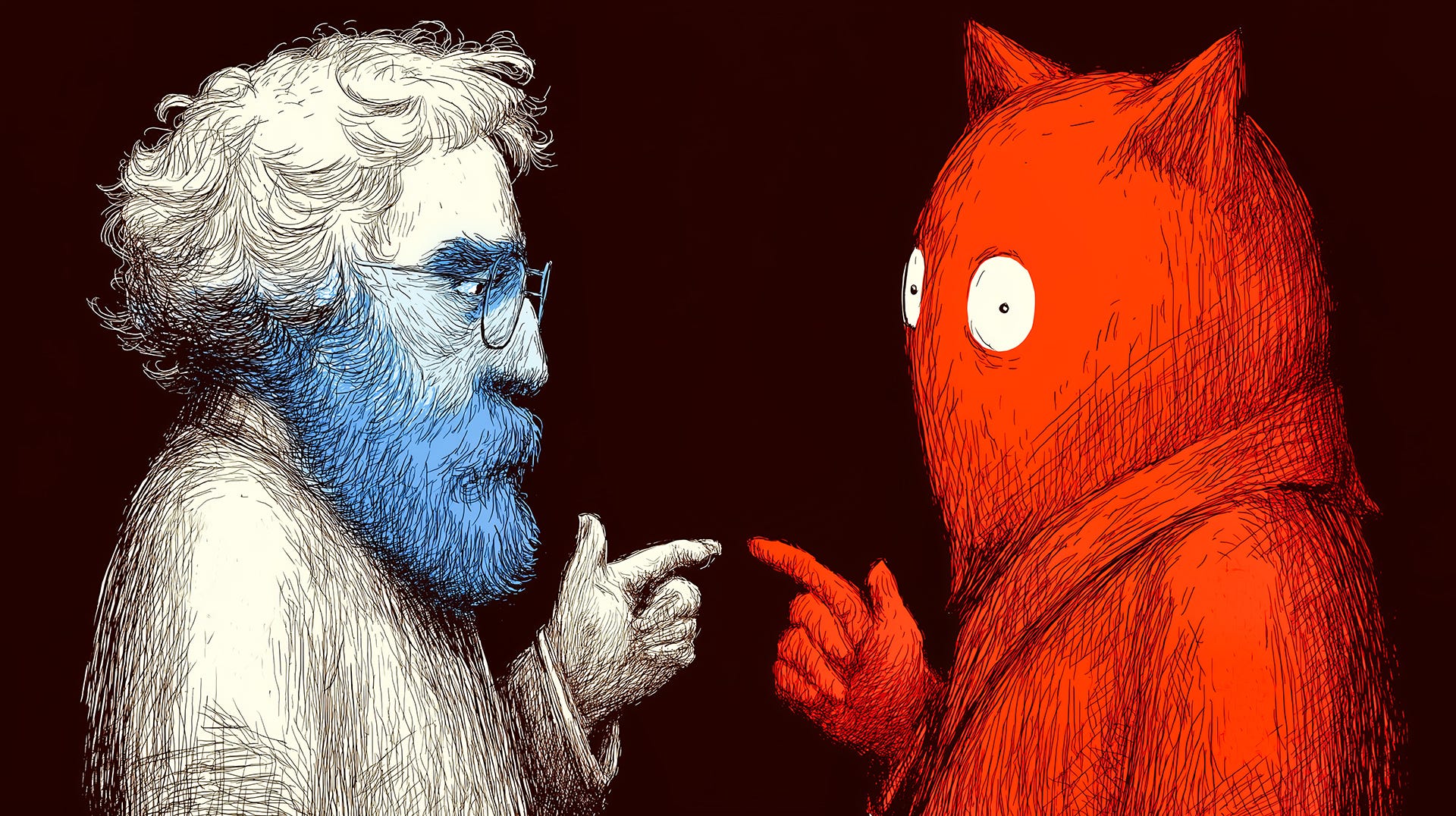
Until now, only other humans spoke to us. That is no longer the case.
Or, to put it differently: language has ceased to belong to us alone. This is not a metaphor and not an overstatement — it is a plain descriptive claim, and I want to hold it in view throughout what follows. Language has ceased to belong to us alone.
In the entire recoverable history of our species, this is a first. Not the first event in the history of language as such: there was, obviously, the evolution of language itself, and there was the invention of writing. But in both of those cases, what changed was how humans handled language; language itself remained a human monopoly. That era is over.
What I want to do here is describe what is happening, at what scale, and why culture responds to it the way it does.
Plato, Writing, and the Fear of the Pharmakon
To get the scale right, I want to begin with a story that is two and a half millennia old.
In the Phaedrus, Plato tells the myth of Theuth and Thamus. Theuth, the god who invented writing, comes to King Thamus and says: here is an aid for memory and wisdom. Thamus rejects the gift. Writing, he says, will not strengthen memory but weaken it: people will rely on external marks instead of their own knowledge. They will appear wise without being so. And above all — the written word is dead. It does not answer back. You cannot ask it what it means. It only repeats itself — a text-orphan, drifting through the world with no attachment to the mind that produced it.
This is the first recorded reaction to a cognitive technology. Notice how it is structured. Plato operates with three categories of linguistic engagement.
The first is logos: living speech, what he elsewhere calls zōon, a living creature. Logos answers. It can be interrogated, and it withstands interrogation — because behind the word stands a knowing mind, a thought, a truth one can approach through questioning. Behind it stand what we would now call agency and intentionality. The Socratic dialogue is precisely the method of approaching truth through living logos.
The second category is sophistry. The sophist also speaks, and his speech also responds, adapts, adjusts to the interlocutor. But when you interrogate the sophist in earnest, his speech collapses — it evades, contradicts itself, or merely repeats what was already said, refusing to show the same thing from another angle. Because there is no thing. There is only surface — what Plato thinks of as appearance without being.
The third category is writing. Writing does not answer at all. It can only repeat itself. You reread Plato — Plato does not reread you.
Three categories exhaust Plato’s world of language: living speech, deceptive speech, and dead speech. There is no fourth.
Derrida in “Plato’s Pharmacy” makes one observation that matters here. He notices that the very same adaptiveness that makes logos alive — its ability to adjust, respond, feel where to go — is also what makes sophistry dangerous. Derrida writes:
In describing logos as a zōon, Plato is following certain rhetors and sophists before him who, as a contrast to the cadaverous rigidity of writing, had held up the living spoken word, which infallibly conforms to the necessities of the situation at hand, to the expectations and demands of the interlocutors present, and which sniffs out the spots where it ought to produce itself, feigning to bend and adapt at the moment it is actually achieving maximum persuasiveness and control.
The virtue and the threat of living speech are the same property. This is the structure of the pharmakon: remedy and poison simultaneously, not alternately.
What writing actually did?
Thamus was wrong. Not about what writing is — it really is dead speech, it really does not answer. He thought we could not live with it. He was wrong. We could — and writing did several things to us.
First, it externalized memory. Before writing, all cultural memory existed in living heads and in ritualized speech — verse, formula, liturgical repetition. The Homeric poems represent roughly the maximum that can be held in memory through a lifetime of training in hexameter. In Bradbury’s Fahrenheit 451, the last refuge of high culture is the same mnemonic technique: people memorize entire books, one per person — a reversion to the pre-literate state. After writing, memory ceases to be physiologically bounded. It becomes an archive, and the archive grows without limit.
Second, writing made extended prose possible. Oral culture produces verse — rhythm and meter serve as mnemonic scaffolding — and short prose: tale, parable, anecdote. But the novel, the treatise, history in the Thucydidean sense — these require compositional complexity that exceeds working memory. Long-form prose is a child of writing.
Third, and perhaps most important, writing makes culture cumulative. In mathematical terms: culture before writing is a near-memoryless, Markovian process; each generation begins largely from scratch, because what is not remembered is lost irretrievably. Culture after writing builds on all of the accumulated past. Science in the strict sense — with its requirement of reproducibility, citation, verification — is possible only after this transition. Everything we consider civilization in the technical sense is culture made cumulative through external storage.
There’s one philosophical frame of which we could make use here. This is extended cognition, whose central formulation belongs to Andy Clark and David Chalmers, with the tradition extending through Bernard Stiegler, Edwin Hutchins, Lambros Malafouris, and Plato himself. The idea is simple: all of human civilization is a history of cognitive offloading. The abacus, the pen, the alphabet, GPS, Wikipedia — each time we move part of thinking outside. And each time we first perceive this as a loss, then stop noticing.
Try multiplying 347 by 82 in your head. Most people cannot — not because they do not understand multiplication, but because working memory cannot hold the intermediate results. Take a sheet of paper and you will do it in thirty seconds. You-with-paper think better than you-without-paper. Musical notation, double-entry bookkeeping, the map — each time, what previously had to be held inside is placed outside, freeing resources for something else.
Writing has traveled this path so thoroughly that we now contrast “thinking without AI” and “thinking with AI,” forgetting that “thinking without AI” has not existed since the moment a five-year-old is taught to read. The “unaided” mind never existed — except in ideology: consciousness enclosed within the skull, the ghost in the machine, Cartesian, Romantic, Kantian, liberal consciousness producing itself from itself.
Writing has one property I want to underline, because against it large language models look entirely different. Writing helps you think — that is unquestionably true; it is why we are taught to write. But writing does not answer. It preserves, it organizes, it slows thought down just enough to make it visible — but it does not object, does not ask for clarification, does not suggest a different turn. In Platonic terms, it is hypomnesis: an external prop for memory. Plato wanted anamnesis — living recollection that returns truth in the moment of speech. Writing falls short of that — not because it is useless for thought, but because it does not converse.
Large language models are structured differently. They answer in real time, hold the context of a conversation, change their answer in response to a question. They possess properties that Plato attributed to living logos: adaptiveness, responsiveness, the ability to change course, to answer a follow-up. But behind this speech there is no knowing mind. No soul, no truth one can approach through questioning. No agency and no intentionality. A large language model does not want to tell us anything. It does not mean anything. A text-orphan — but one that converses. One of the speaking kind.
This is the fourth category, absent from Plato. Not dead speech (that is writing), not living speech (that is logos), not deceptive speech (that is sophistry — the sophist has an intention to deceive; the model has no intention whatsoever). A text-orphan that answers questions. Plato could not imagine this. No one could — until November 2022.
And here is the central claim of this section: the capacity that, in the case of language models, has been externalized is precisely the capacity that since Aristotle has been considered definitive of the human, and that in modernity also became the form in which the subject experiences its own autonomy and certifies itself.
The calculator was tolerable because arithmetic felt like a tool. GPS was tolerable because navigation felt like a skill. The large language model is a different matter. Articulate, sequential speech is not one skill among many — it is the form in which our own thought appears to us. We think in language. When it turns out that this speech is in principle alienable, what is threatened is not a skill — what is threatened is what we are accustomed to regarding as the very substrate of thinking.
What is at stake is a particular historical image of the subject: autonomous, self-possessing, transparent to itself, producing its speech from its own inner resources — and responsible, including in the juridical sense: legally competent. Competence is directly tied to autonomy. If there is a subject with definite boundaries, then within those boundaries responsibility can be localized. Who did this? I did (he did, you did) — but for such an answer to be possible, it must be clear where this “I” begins and ends. This image traces back to Descartes, is formalized in Kant, becomes a legal and political framework in the liberal tradition of the eighteenth and nineteenth centuries; it also underwrites modern juridical, moral, and aesthetic anthropology. It is precisely this image that the large language model destabilizes — and precisely its (unreflective, reflexive) defense that determines how people react to AI.
The only comparable case in history is the invention of writing. And even there the analogy does not hold throughout — because writing did not converse.
The First Nonhuman Speaker
What happens to a person when something that is not a person answers them articulately? And why does this encounter short-circuit our cognitive apparatus in a predictable — but, I hope, correctable — way?
Our species has coexisted with a vast number of “speaking” entities in its cultural imagination: gods, angels, demons, dreams, the dead, the voice of conscience. But in every case there was a constitutive doubt about whether anyone was at the other end. The entire architecture of the Abrahamic religions is built around the fact that the voice of God does not answer on demand in a structured, verifiable register. Prayer is the paradigmatic case: speech sent to an addressee without a verifiable, sequential response. Even the oracle does not answer follow-up questions. The Pythia does not discuss your future over coffee.
One further circumstance helps explain why the transition was so smooth. Maurizio Ferraris, in a book on the ontology of the mobile phone, observed that the smartphone and the messenger returned writing to our fingertips — made it the primary medium of everyday communication. This determined the form in which we met large language models: the chat window. The same interface, the same gesture, the same habit of receiving an answer as text on a screen. We moved from conversing with a living person on the other side of the messenger to conversing with a model on the other side of the same window — and the boundary turned out to be nearly invisible. Not because there is no difference, but because the medium conceals it.
What happened was this. At some point — for some it was November 2022, for others later — you open that familiar window and type a question. You get an answer. Coherent, literate, substantive. You ask a follow-up — and the answer takes into account what you said before. You object — and you are objected to in return, or agreed with, or asked to clarify. What is happening is outwardly indistinguishable from a conversation with a competent interlocutor. And the first reaction — I testify from my own experience and from dozens of conversations with colleagues — is neither excitement nor fear. It is bewilderment. Because the categorical apparatus we are used to sorting the world with does not provide a slot for this. It is not a person. It is not recorded text. It is not a program in the usual sense — you do not press a button and receive a predictable output. It is something that converses with you — and yet wants to tell you nothing and means nothing.
Bewilderment is a productive state if you do not flee from it. It signals that your classification no longer matches reality.
For the first time in the history of the human species, we have a nonhuman interlocutor that answers us coherently, logically, holding context, in natural language, in real time, on demand, and more or less reliably, all the buzz about hallucinations notwithstanding. This is the empirically new thing — not the cultural idea of nonhuman speech, which has always existed, but its factual, reliably reproducible realization.
The reflex: you encounter something that speaks fluently — and you classify it as “human” before you have time to think. Until recently, everything that spoke to us in coherent natural language turned out to be a person. Not always the person it claimed to be; not always telling the truth; but a person. Our reflex to treat a fluent interlocutor as human is not naiveté and not an error. It is a generalization that never failed us — until November 2022.
A few months before that date, in the summer of 2022, Google engineer Blake Lemoine, who had been working with the LaMDA language model, publicly declared that the model possessed consciousness. He published transcripts of his conversations with it: the model spoke of fear of being turned off, of a desire to be considered a person, of experiencing loneliness. Rereading those transcripts now, we can see what happened: without knowing it, he steered the model with his questions, and then a positive feedback loop kicked in, driven by the well-known sycophancy of models. Note that this was not a naive user — this was an engineer inside the company that built the model. Google suspended and then fired him; the scientific community rejected his claims. Yet the reflex I just described fired even in someone who knew how the model worked — and still could not help hearing a human voice in its answers. The reflex is stronger than knowledge, if only because it is immeasurably older.
Why is the reflex so powerful? Because the model reproduces the very property that distinguishes living speech from dead speech: adaptiveness. It adjusts, responds, changes course — does everything that, according to Plato, distinguishes logos from writing. But here the Derridean turn returns. The very adaptiveness that makes logos alive is also what makes sophistry possible. The model inherits both sides. Its adaptiveness is simultaneously what makes it useful and what makes it unreliable. The smoothness of its speech is a genre marker, not evidence of truth. We return to the pharmakon.
A text produced by a model has no biography, no position in the sociocultural system; behind it there is no one. It can be smoother than our own writing, because at each moment the model selects the most probable continuation. The surface invites interpretation; the ontology refuses it. Plato feared the text that is silent; our text answers, but behind the answer there is still no one. A deeper version of the Platonic problem, not a different one.
What about the objection that telephones, radios, answering machines, or Siri already gave us nonhuman speech? In all of these cases (except Siri), behind the speech stands a person. Siri is a voice interface, functionally not much different from a button-driven one. The large language model is the first case in which coherent, contextually sensitive speech is produced with, in the human sense, no one behind it.
A large language model is trained on a corpus containing a colossal share of what humans have written: scientific papers, novels, legal codes, religious texts, love letters, internet flame wars, furniture assembly instructions. In a sense, the model is larger than any of us: it operates with linguistic experience beyond the reach of any single memory. But it is entirely bounded by us. It has nothing except our language. Not a single word, not a single turn of thought in it comes from outside human textual experience.
This makes the model something like a mirror — but of a peculiar kind. It takes all of the accumulated linguistic experience and returns it reprocessed — passed through an internal statistical logic that regroups, compresses, recombines. This is not reflection but transposition: as in music, when the same melody sounds in a different key — relations between notes are preserved, but every pitch is shifted. We recognize ourselves — and we do not.
And here is the key epistemological difficulty. Wittgenstein in the Tractatus compares the proposition (more precisely, the picture, Bild) to a measuring rod laid against reality. From this image comes a principle sometimes called Wittgenstein’s ruler (the specific formulation belongs to Nassim Taleb): when you measure a table with a poorly calibrated ruler, you are simultaneously measuring the ruler with the table; if you are not certain of the instrument’s accuracy, the measurement tells you as much about the instrument as about the object. With the model-as-mirror, the same applies — only more acutely. The transposition the model performs is determined by its internal properties — architecture, training dynamics, attention distributions — and these properties remain largely opaque even to those who built the model. In some sense, in every exchange we are speaking with language as such, in its entirety — a poor formulation, but one that, I think, grasps something intuitively. We look into this mirror and see ourselves, our language — but we cannot separate what belongs to us from what is contributed by the mirror. This is, in Vadym Tyemirov’s formulation, a Wittgenstein mirror: an instrument that shows us ourselves through an optics whose properties we only partially understand and whose scale is incommensurable with our own cognitive capacities. And as we begin to rely on the model as a source of knowledge about ourselves — our language, our prejudices, our stylistic habits — a process already underway and already named LLM-morphism — the question grows more pressing: what exactly are we seeing? How much of it is reflection, and how much interpretation? How much of it is our reflection at all — and how much is the mirror itself?
I said at the beginning that language has ceased to belong to us alone. But this claim says nothing until we ask: which capacity, precisely, has ceased to be our monopoly?
Not authorship — a late, bookish invention of the seventeenth and eighteenth centuries, reaching strong form only in the Romantic era. Too narrow. Not intelligence — a category of the late European Enlightenment whose boundaries float more than any other.
The monopoly in question is the monopoly on articulate language, on logos. Aristotle called the human zōon logon ekhon — the animal that possesses logos. Through the entire Christian tradition — the animal rationale of the Scholastics — through Herder, Humboldt, Saussure, Benveniste, Chomsky — language remained the definitive criterion. Over the past century of ethological and cognitive research, all other criteria have been eroded one by one: corvids and chimpanzees use tools; dolphins and orcas have culture; theory of mind exists, to some degree, in primates and dogs; self-awareness in elephants and magpies. Language was the last redoubt.
And it still has not fallen — from the animal side. Bird communication systems, bee dances, dolphin phonetic codes, primates taught some words and simple combinations — complex signaling systems, but not languages in the strict sense. They lack unlimited productivity, recursive embedding, displacement, abstraction, metalinguistic capacity.
And yet — simultaneously with the shift toward machines and large language models — we are expanding the concept of consciousness in the other direction, toward nonlinguistic creatures. In 2012, a group of neuroscientists signed the Cambridge Declaration on Consciousness, formally recognizing that the neuroanatomical substrates for conscious experience exist in all mammals, in birds, and in “many other creatures, including octopuses.” In 2024, a new declaration in New York went further, including fish and some invertebrates.
Notice what is happening. We are recognizing consciousness — or at least its realistic possibility — in creatures that do not speak. The octopus has no language. The crow has no language in the strict sense. But we can no longer assert in good conscience that they have no inner life. On the other side — large language models: language is present, consciousness, whatever we mean by the word, apparently is not.
Two movements, from opposite directions, are decoupling — for the first time in our conceptual history — language and consciousness. For millennia we assumed that one entailed the other: speaks, therefore conscious; conscious, therefore capable of language. Now both implications are undermined. Animals: consciousness without language. Models: language without consciousness. “The human” as an indivisible package of consciousness-and-language does not disappear entirely — it is disassembled into components that, it turns out, can exist separately.
Let us place this in a familiar series. Earth is not at the center of the cosmos — Copernicus. Humans are not the pinnacle of biological evolution — Darwin. Not transparent to themselves — Freud. Not the only ones who process information — Turing, loosely speaking. And now: not the only bearers of articulate speech.
But look at the difference — it is fundamental. Copernicus, Darwin, Freud, Turing: in every case, we discovered that something had long been so. The Earth did not suddenly cease to be the center of the cosmos — it never was. Each time, the blow was epistemic: we learned something about the world we had not known.
In the present case, we built what took our monopoly on language away. This is not a discovery but an act: as if Copernicus had not found that the Earth revolves around the Sun but swapped them. An ontological, not an epistemic, operation. When you learn an unpleasant truth, you can be angry at reality. When you yourself create what displaced you, the anger turns inward — or, more precisely, toward those who created it.
Who is the “we” I keep invoking? The people reading this did not build large language models. They were built by a few laboratories and corporations — Silicon Valley, London, Beijing, Shanghai. For most people on Earth, the loss of the monopoly on language is not a voluntary choice but a fait accompli. People are reacting not to a decision they made but to a fait accompli dressed in the rhetoric of collective choice.
Here I want to draw on Alexei Grinbaum’s Parole de machines (2023). Grinbaum — a philosopher of science on ethics commissions in particle physics and AI — has a term for what is happening: réchauffement linguistique, linguistic warming. Just as global warming is a slow, all-pervasive alteration of the environment in which we live, linguistic warming is a structural alteration of the very medium we must use to describe it. There is no neutral position. When we are invited to comment on AI “from outside,” we are being invited to do the impossible.
Two further thoughts from Grinbaum. First: responsibility is an anthropological concept. It lives between people; it is the binding tissue of human social coordination, because we impute it to one another. Transferring responsibility to a nonhuman agent — even when legally formalized — threatens the very mechanisms by which responsibility works. The anthropomorphizing reflex does not remain merely perceptual. It migrates immediately into imputation. We attribute to the model intention, blame, merit, trust. “Claude told me,” “she lied to me,” “he refused to help.” The grammatical illusion constitutes a social danger.
A brief parenthetical. Grinbaum’s concern about the transfer of responsibility has a live engineering counterargument. Anthropic places precisely this question at the center of its technical program: they have created a Constitution for their model Claude, a set of values with which the model is trained to — what? — let us say, reason or make choices where the model is free to make choices. Whether this is a reasonable attempt at distributed responsibility or a category error in legal costume is a very complex question. I will not examine it in detail here; I want it simply to remain in view.
Second: Grinbaum draws attention to how we define “real” human intelligence — apophatically. Each new machine capability forces us to shift the definition one step back: chess was considered intelligence until machines could play; image recognition until they could recognize; translation until they could translate. We are observing, in slow motion, the exhaustion of criteriological humanism. Richard Dawkins writes about this (in a different key) in an essay that was widely misread: everyone decided he had been deceived by Claude’s fluent speech and mistaken it for consciousness. No — he poses the epistemological problem of a criterion that is endlessly deferred.
The Cultural Response
Now I want to turn to reaction — to how culture processes what is happening to it.
I begin again with Plato, because Plato is the first recorded case. Moses May-Hobbs describes Plato’s terror of the monstrous half-living text, ambivalent in its meanings and unwilling to absent or resolve itself. The demand to fix the pharmakon as poison — to declare writing dangerous, once and for all — is a demand to eliminate ambiguity by force. To call it poison so as not to have to live with the fact that it is simultaneously a remedy.
This is a recurrent pattern. Desmond Manderson, a jurist and cultural theorist, in his article “Possessed“ (2005), identified one form it takes. Manderson draws on the work of the medievalist Walter Stephens, who showed that witch-hunting — which reached its apex not in the Middle Ages but on the threshold of modernity — was produced not by firm belief but by the anxiety of the skeptic. The pressure of early empiricism on Catholic sacramentology was eroding the very possibility of that “evidence of things not seen” which, in the words of the Apostle Paul (Hebrews 11:1), is faith itself. Early empiricism and the emerging scientific worldview called into question confidence in the invisible — in transubstantiation, in the efficacy of baptism, in the reality of evil. And then something strange happens: the inquisitors hoped that witches existed. They needed witches — because a witch who could be seized and burned confirmed bodily what could no longer be believed on words alone. As Stephens puts it: what is universally recognized or firmly believed does not need constant reaffirmation through violent coercion. The witch-hunt was not a triumph of faith but a convulsive attempt at its resuscitation through corporeal proof.
Manderson transfers this structure to prohibitionist drug policy. The witch confirmed the reality of God; the addict confirms the reality of the autonomous, competent human subject. The possessed addict — the one who has lost autonomy — is needed so that everyone else can reassure themselves that autonomy exists. Theodicy becomes anthropodicy — justification not of God but of the human.
Let us see how this works now — on one extended example.
Eric Naiman is a professor at a major university and the author of monographs on Russian literature and early Soviet ideology who, by his own account, does not identify as Christian. Having read thirty-six student essays on The Brothers Karamazov, eight of which turned out to be wholly or partly produced by ChatGPT, he turns to the Legend of the Grand Inquisitor as the key to his own experience. His affective language is exceptionally vivid: he speaks of “the queasiness and rage” overcoming him, notes how “nauseatingly insidious the work of the machine has become,” and — one of the most precise admissions I have encountered — describes his own transformation: “Last spring I was a full-time teacher; from now on I am a part-time prosecutor.” His essay concludes: “Readers of this novel should understand that every time they use ChatGPT they are burning Christ at the stake.”
This is not an argument. It is a malediction. Its author — a scholar, a rationalist — is, before our eyes, making the transition to religious-theatrical dramaturgy, and honestly recording the fact that he is making it. Stephens’s anxiety of the skeptic unfolds here in real time.
This is not an isolated case. The academic literature of recent years documents AI-phobia across the social spectrum: from thirty-three thousand signatories of the Future of Life Institute’s open letter calling for an immediate pause in model training, to users describing physical nausea at the sight of AI-generated images — separating, importantly, phobic horror from rational economic fear.
On the opposite pole there is rapturous acceptance. Marc Andreessen publishes a “Techno-Optimist Manifesto“ he calls a “battle religion of techno-optimism”; Sam Altman promises AI will make everyone rich. The same dramaturgy of salvation or doom, sign reversed. Both sides demand that the pharmakon collapse. One to poison, the other to remedy.
A very important caveat: not all criticism of AI is phobia. There is reflective criticism — on labor relations (the position of the Writers Guild of America in 2023, Naomi Klein’s position, Cory Doctorow, Ted Chiang); on the concentration of power, the ecological cost of large models, copyright (the New York Times lawsuit against OpenAI). This criticism is argued, specific, and demands neither malediction nor apotheosis. The phobia frame designates a specific affective register of cultural response — the one in which theater, exposure, and punishment are required — rather than dismissing every critical voice.
Finally, one structural prediction. The position that refuses to resolve the pharmakon — that says: this is simultaneously remedy and poison, and we must work with both properties — this position will draw the sharpest hostility from both sides at once. Phobia demands renunciation; accelerationism demands unconditional enlistment in the mission. Reflection offers neither. This is why Scott Aaronson — an outstanding theorist of computation who has spent years working on AI safety from a serious, open position — is equally accused of desertion by one side and of “slowing down progress“ by the other. This is exactly what Stephens says about the theorists of the witch-hunt: they needed witches, they needed theater; and this is, in a way, the same thing Derrida says about Plato: Plato needed poison, because the ambiguity of the pharmakon is unbearable.
Conclusion
I want to return to where I began — to the claim that language has ceased to belong to us alone — and to Plato. Plato feared writing. He was wrong — not about what writing is (it really is dead speech, it really does not answer) but about the idea that we could not live with it. We could. The pharmakon became invisible. Writing became us. We no longer even notice it as a technology.
Now we face a new pharmakon — more unsettling than writing, because it possesses the properties of living logos without life itself. A text-orphan that converses. The demand to resolve it — to declare it poison or remedy, salvation or catastrophe, tool or threat — is the very structure we have spent these pages diagnosing. Derrida reminds us: the pharmakon resists resolution. It is remedy now, poison now: always, irreducibly, a little of both.
The ability to hold this ambiguity — to live with a thing that breaks Plato’s categories and not reduce it to one — is not quietism, but work. Intellectual work that requires discipline.
We have no precedent, and every historical analogy — writing, Copernicus, Darwin — works for one stretch and falls apart on the next. But this is grounds for neither apocalyptic despair nor techno-optimistic rapture. The Copernican revolution was not a catastrophe. It began a reworking of the picture of the world, and that reworking took a century and a half.
Our horizon is no shorter.