
Vibration Frequency
A border begins with something small: a sign, a warning, a few sandbags stacked one upon another

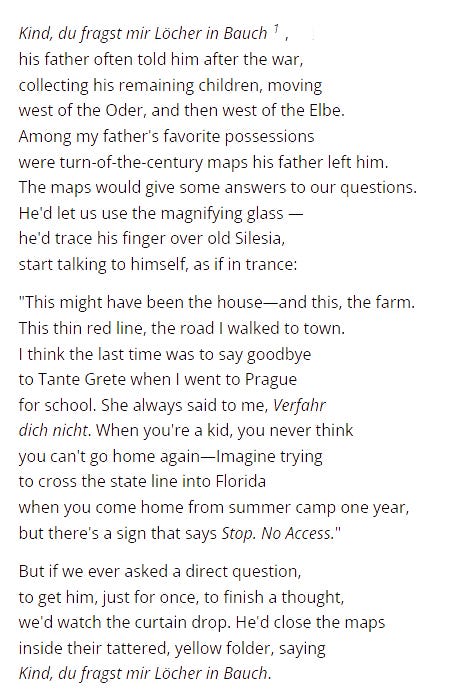
This is “Delineations,” a poem by the American poet Diane Thiel from her book Echolocations . I translated Delineations a long time ago and had all but forgotten about it, until it surfaced one morning from a file that had somehow survived on one of my external drives. But the poem I happen to know by heart, almost.
In German there is the word Heimweh — longing for home, literally an illness. Swiss physicians of the seventeenth century considered it the lot of mercenary soldiers. Johannes Hofer, who described the condition in 1688, listed the symptoms: insomnia, fever, quickened heartbeat at the sound of a native dialect, apathy, refusal of food. The cause of the disease: “constant vibrations of animal spirits through the fibers of the midbrain, where traces of ideas about the homeland are preserved.” The treatment protocol: opium, leeches, return to the Alps.
The vibrations are relevant here because Hofer linked Heimweh to the idea that every landscape produces specific oscillations of the air, peculiar to it alone; the body grows accustomed to “its” frequency, as it does to the composition of the water or the mean annual temperature. Away from home, the frequencies are different — and the body begins sending distress signals. The etiology is somewhat naïve, but the observation is precise: separation — whether from a landscape or from a person — is an event as somatic as it is spatial. Not necessarily a tragic event; perhaps more often, an ambient one. Sleep, it seems, has gotten a bit worse; appetite a bit weaker; everything somehow irritates; patience for trifles runs short. A person seems to be living in a new place, but the timetable inside is the old one: an alarm seems to ring, but you look at the clock on your phone — and it’s still dark, five in the morning.
*
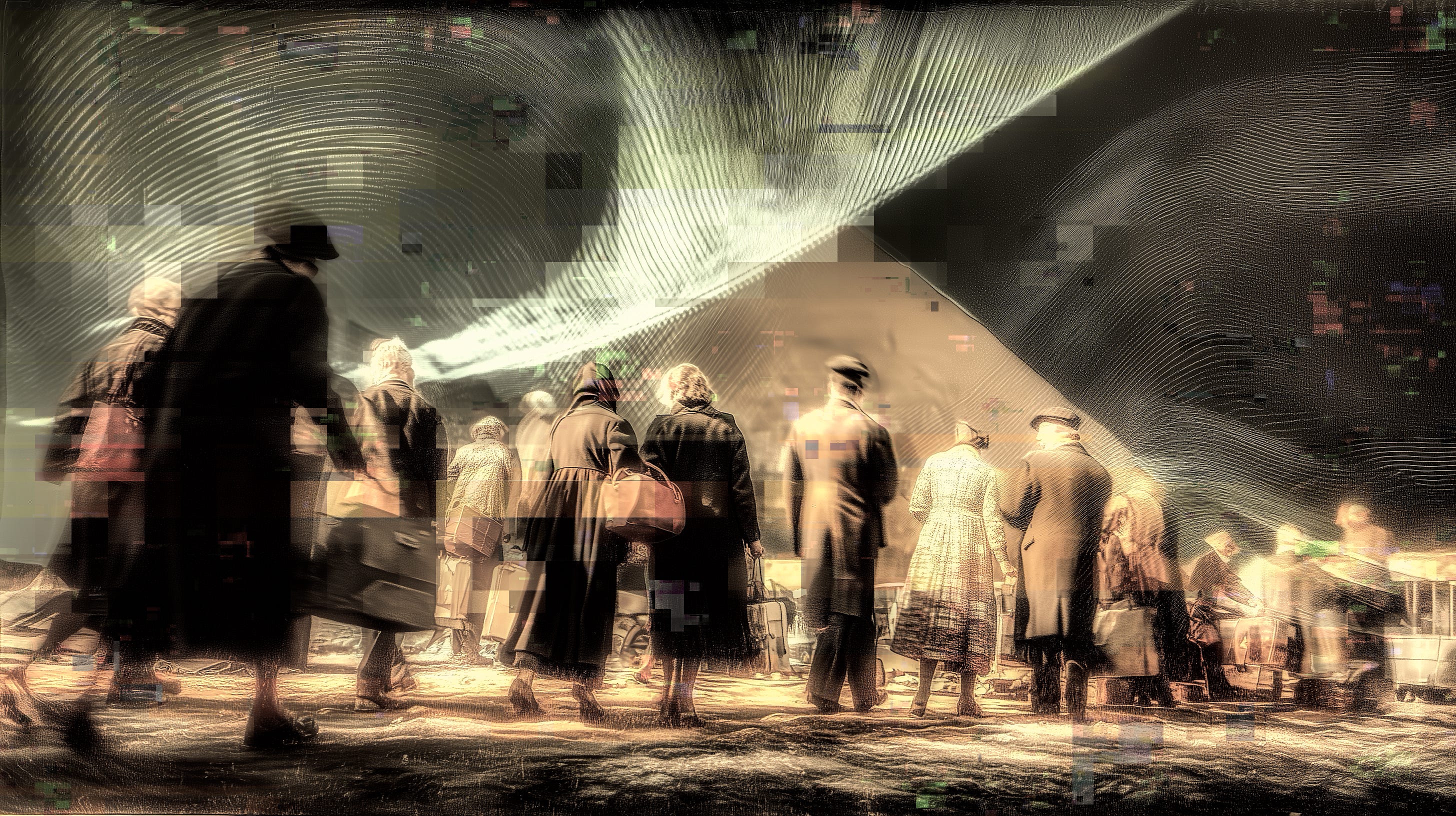
Between 1944 and 1950, approximately twelve million ethnic Germans were expelled or fled from Silesia, Pomerania, East Prussia, the Sudetenland, Eastern Brandenburg — territories where their families had lived for generations. Estimates vary; sometimes the figure given is fourteen million, if one includes the Germans of Hungary, Yugoslavia, and Romania. Estimates of the dead range from hundreds of thousands to several million: hunger, cold, disease, roads, universal hatred, displaced persons camps. Exact numbers are difficult to establish: the past is a foreign country — one that is, moreover, receding from us at the speed of time.
They took what they could carry. One suitcase — an official directive, confiscation with a sentence. Photographs, documents, letters. Sometimes maps — though hardly to check a route against them. More like this: this place existed; a house stood here; here is the road, the river, the cemetery, a former shopping center. Here was the school. Not evidence, no — courts don’t accept that sort of thing. Memory is less exacting; as a keepsake, it will do.
*
A map is a promise of order. A thin red line says: a road exists here; one can pass. A blue, uneven vein of river says: water flows, somewhere out there is the sea, and the sea does not overflow. A black dot with a name printed above it to the upper right says: here is a town; it is located here. This is the language of certainty; it says: you can rely on me.
But what does a map know of renamings, of shifting borders, of the first decrees of newborn jurisdictions, of how here and now come apart once again — rough sutures, hastily placed in a hospital never fully evacuated. The road now leads to a foreign country; the river has received another name; the forest was cut down and replanted — look, saplings already; the cemetery has been moved. The house survived; people live in it again — other people.
A map is something like a frozen version of the world. A snapshot of history that for a time seemed final.
As a child, I thought the landscape would outlast me — and all of us — by far; after all, it had always been here. But landscape turned out to be one of the most mutable forms assumed by the idea of finality. A day simply comes — at first exactly like all the other days. Later it will be recalled, its events reconstructed, told to children — but for now it is simply a day on which landscape and map come apart: the neat edges of a deep trench dug overnight in the depths of the park by the city hospital.
*
Verfahr dich nicht, don’t get lost — says Tante Grete to her nephew leaving for Prague to study. An ordinary farewell: don’t lose your way out there, look around you, remember the turns. Home is the place from which you are let go.
In space one can get lost, lose one’s way, go astray — but only as long as the space itself is not lost. Otherwise you might walk out the door one morning and discover there is no longer a road back — and it isn’t that you took a wrong turn; it’s simply that now there is a different street, one that looks the same as the old one and bears the same name. Only if you stop in the middle of the crossing and turn your head do you see that the tram tracks are diverging, not converging to a point. A moment ago you were here — and suddenly you find yourself on the other side of the perspective, looking outward from the wrong side. A border begins with something small: a sign, a warning, a few sandbags stacked one upon another. Yesterday you were still visiting, or even coming home; this morning you are already crossing over, and by evening — crossing a border. But at some point you do come to rest somewhere, on one side or the other.
What good is our map — when everyone is already lost? Navigation by it is impossible; all you can do is take it out, unfold it, and point: here — see? — was the Bird Market. From here there was a trolleybus to the regional theater. Here there was a street — we were at the same school, parallel classes — and the street was called — but no, I can’t recall the face, anything.
There is a kind of longing that looks nothing like longing. It requires neither words nor tears, not even a song to sing; it switches on for a moment — and switches off: the smell of autumn leaves, the intonation of a passerby gesturing with his arms, light from a streetlamp outside the window falling at a slant. Memory doesn’t stage performances; it makes do with brief live feeds.
*
A friend of mine who back then in the early nineties, has left Tashkent, where his childhood had been spent, told me how he went back once, after twenty years, maybe twenty-five. The streets were the same — but not the same. The aryk along the mahalla had been filled in, paved over with tile. The mulberry tree in the courtyard had been cut down. Where the bakery used to be, there was now a mobile phone shop. The building was still there — the entrance, the steps, the window on the third floor. He stood and waited, as though something were supposed to happen. Nothing was happening. Nothing happened. The animal spirits were silent, and everyone was silent, and everything was silent. And there was nothing there, he told me afterward, nothing of what I had missed so terribly. Neither his twelve years were there, nor his grandmother alive, nor that mulberry tree in this courtyard, nor the taste of those lepyoshki in these lepyoshki, nor the clang of a tram at the turn — the route had long been discontinued, and now he wasn’t even sure the turn had been there at all.
My friend, at any rate, no longer goes to Tashkent, but he says he occasionally flies there at night — to look at the city from afar and from above, trying to guess from the color of the vegetation when the satellite image was taken. The image can be zoomed in — but not too close; better not to make out the details. It can be held — but not for very long: not in memory; on a screen.
*
Borders almost always begin on paper. A pencil-drawn line, a peace agreement, a League of Nations resolution, a decision to rename in someone’s honor, a prosecutor’s order, a trial in absentia, a sentence. A new set of toponyms, a new registration procedure, documents of a new type. The Oder-Neisse date line: before — after, here — there. On one side, you are home. On the other — a displaced person. How do you speak of yourself? Who are you now? Do you have a primus stove, a kettle, a tap?
Why, when the children began to ask questions, did he fold the maps?
Because a map like this, from the past, is not an object, not a source, not a symbolic representation of territory. It is a ritual that works only in the absence of full clarity. While the finger moves along the line of demarcation, while the voice says “right here, probably” — the past is sustained as a (former) probability. Direct questions demand certainty: where exactly? why? who? what happened next? At that moment the map returns from the imagination of places to its paper body — well-preserved, dense, barely worn at the folds, barely frayed at the edges, prewar, slightly faded, insufficient, too detailed.
And so the map must be folded. Put back in the folder. Eyes closed. At the turn, a tram clangs; the station trembles with the singing of animal spirits; shuffling shadows take their seats in the upper balcony of the old regional theater; the performance begins — the incantation.
*
Whoever managed to return discovers that little of the former world remains in place: the name of the island, the layout of the palace rooms, the name of the dog that has grown old. What brought him here? Heimweh? A quickened heartbeat? The smell of lepyoshki? Sehnsucht? A native dialect? Google Maps?
Kind, du fragst mir Löcher im Bauch.
*
[Originally published in Russian as part of the Home Address: Collected Essays and Short stories. — Vidim Books; Braislava, 2026]
[1] "That's enough questions, child" (lit. "You'll ask holes right through my stomach") — Germ.